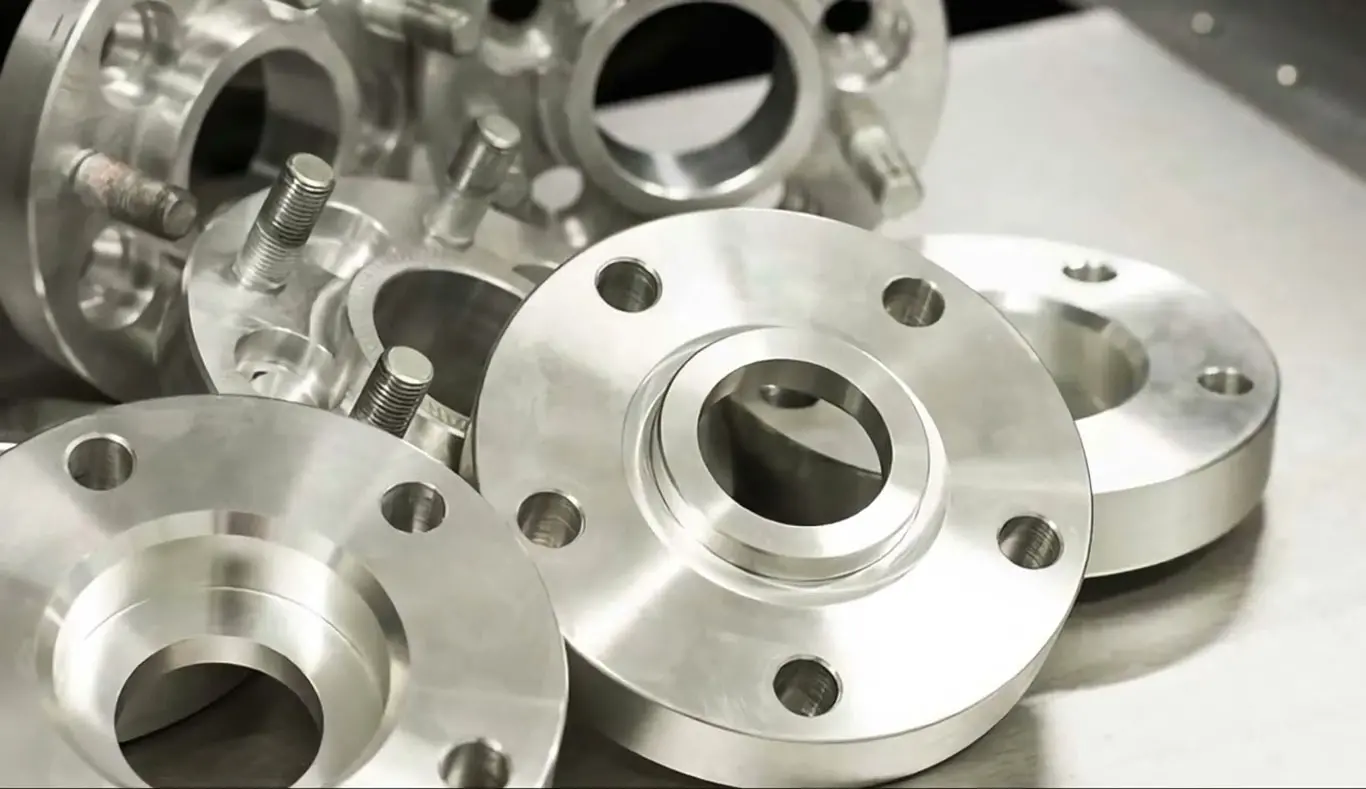
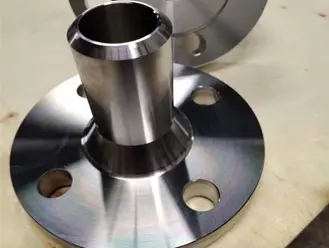
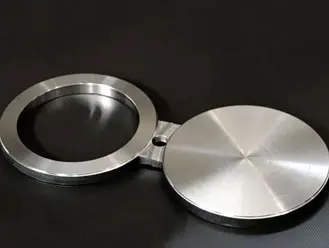
Nickel 200 and Nickel 201 Flanges

Nickel 200 and Nickel 201 Flanges - ASTM B564 Supplier in Mumbai

Nicorex Alloys is an ISO 9001 / ISO 14001 certified, trusted supplier of Nickel 200 and Nickel 201 flanges based in Mumbai, India. We provide flanges manufactured in accordance with ASTM B564 / ASME SB564 standards.

Nickel 200 and 201 contain a minimum of 99.0% nickel, giving them extremely high nickel purity for engineering use. Nickel 200 (UNS N02200, Werkstoff 2.4060/2.4066) contains a maximum of 0.15% carbon, while Nickel 201 (UNS N02201, Werkstoff 2.4061/2.4068) contains a maximum of just 0.02% carbon. This difference in carbon content is the key factor when choosing between the two grades. Nickel 201 must be used above 315°C (600°F) because its lower carbon content prevents graphitisation, which can affect Nickel 200 at higher temperatures. Commercially pure nickel is the preferred material for handling molten sodium hydroxide at concentrations up to 100% and temperatures above 315°C. As a result, Nickel 200 and Nickel 201 flanges are widely used in chlor-alkali plant piping, caustic evaporator connections, and concentrated NaOH transfer headers. Typical tensile strength values are 380 MPa (55 ksi) for Nickel 200 and 345 MPa (50 ksi) for Nickel 201, with a yield strength of about 103 MPa (15 ksi). Thermal conductivity is about 70.2 W/m·K. Types include weld neck (WNRF), slip-on (SORF), blind (BLRF), socket weld (SWRF), threaded, lap joint, long weld neck (LWNRF), ring type joint (RTJ), spectacle blind, and reducing flanges. Sizes range from NPS 1/2″ to 24″ (ASME B16.5) and from NPS 26″ to 60″ (ASME B16.47). Pressure classes are available from 150 to 2500.

Both Nickel 200 and Nickel 201 are magnetic and have a Curie temperature of about 358°C. Typical applications include caustic soda production, fluorine and UF₆ processing, food and pharmaceutical piping, and aerospace systems. We provide EN 10204/3.1 mill test certificates with every shipment.

Nickel 200/201 Flanges

Nickel 200/201 Flanges Specifications

Nickel 200/201 Flanges are available in different grades, types, sizes, pressure ratings, face styles, and dimensions:
Specification ASTM B564 / ASME SB564
Flange Types WNRF, SORF, BLRF, SWRF, Threaded, Lap Joint, LWNRF, RTJ, Spectacle Blind, Reducing
Size (B16.5) NPS 1/2” to 24”
Size (B16.47) NPS 26” to 60”
Pressure Class 150, 300, 400, 600, 900, 1500, 2500
Face Types RF, FF, RTJ, Tongue & Groove, Male & Female
Dimensional Standards ASME B16.5, B16.47, B16.36, B16.48, MSS SP-44, EN 1092-1, JIS B2220

Nickel 200 vs Nickel 201 Flanges - Grade Selection Guide

Both grades share identical corrosion resistance. Nickel 200 (C 0.15% max) gains strength from carbon but is susceptible to graphitisation above 315°C. Nickel 201 (C 0.02% max) avoids this; ASME BPVC-approved up to 677°C.
Property Nickel 200 (N02200) Nickel 201 (N02201)
Carbon Content 0.15% max 0.02% max
Min Tensile 380 MPa (55 ksi) 345 MPa (50 ksi)
Max Service Temp 315°C (600°F) 677°C (1250°F)
Graphitisation Risk Yes, above 315°C No
Preferred Use Ambient-temp caustic, HF acid, food-grade High-temp caustic evaporators, molten NaOH
For caustic solutions above 315°C and stronger than 50%, use Nickel 201. For room‑temperature hydrofluoric acid or food-grade service, you can use either Nickel 200 or Nickel 201.

Chemical Composition of Nickel 200/201 Flanges

Chemical composition details for Nickel 200 and Nickel 201 flanges, listing alloy elements and limits defined for each grade:
Grade Nickel (Ni) Carbon (C) Manganese (Mn) Silicon (Si) Iron (Fe) Copper (Cu) Sulfur (S)
Nickel 200 (N02200) 99.0% min 0.15% max 0.35% max 0.35% max 0.40% max 0.25% max 0.010% max
Nickel 201 (N02201) 99.0% min 0.02% max 0.35% max 0.35% max 0.40% max 0.25% max 0.010% max
Carbon is the defining distinction. In Nickel 200, it strengthens the matrix but precipitates as graphite above 315°C. In Nickel 201, the 0.02% max carbon eliminates graphitisation risk. Both grades share identical corrosion resistance.

Mechanical Properties of Nickel 200 Flanges

Mechanical performance data for Nickel 200 flanges supplied in the annealed condition, including strength and ductility values:
Grade Tensile Strength (min) Yield 0.2% Offset (min) Elongation (min) Density Melting Range
Nickel 200 (N02200) 380 MPa (55 ksi) 103 MPa (15 ksi) 30% 8.89 g/cm³ 1435-1446°C (2615-2635°F)
Nickel 201 (N02201) 345 MPa (50 ksi) 103 MPa (15 ksi) 30% 8.89 g/cm³ 1435-1446°C (2615-2635°F)
Commercially pure nickel has moderate strength; its value lies in corrosion resistance. Nickel 200 achieves slightly higher tensile (380 vs 345 MPa) from carbon strengthening. Thermal conductivity: 70.2 W/m·K, far exceeding Monel 400 (21.8) or Inconel 625 (9.8).

Nickel 200 and Nickel 201 Equivalent Grades

Nickel 200 and Nickel 201 equivalence chart, listing corresponding international grade designations used across global standards:
Grade UNS Werkstoff Nr. EN JIS AFNOR
Nickel 200 N02200 2.4060 / 2.4066 Ni 99.2 / NW 2200 NW 2200 N-100M0
Nickel 201 N02201 2.4061 / 2.4068 LC-Ni 99 / NW 2201 NW 2201
Manufacturers often certify material as both N02200 and N02201 when the carbon in the heat is below 0.02%. Verify the MTC to confirm grade compliance.
Premium Industrial Materials

Get Nickel 200 / 201 Flanges at Competitive Prices

ISO Certified
Custom Sizes
Fast Delivery

Types of Nickel 200/201 Flanges in Stock

Available Nickel 200/201 forged flanges per ASME B16.5 and B16.47:
Nickel Weld Neck Flanges

Nickel 201 Weld Neck Flanges (WNRF)

Nickel Slip On Flanges

Nickel 200 Slip-On Flanges (SORF)

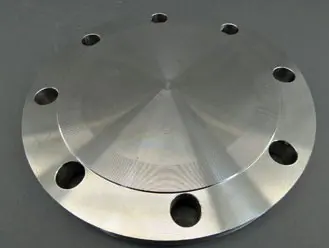
Nickel Blind Flanges

Nickel 201 Blind Flanges (BLRF)

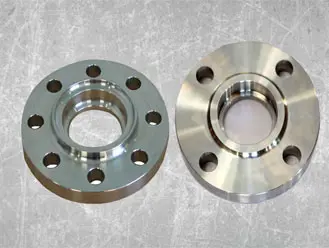
Nickel Socket Weld Flanges

Nickel 200 Socket Weld Flanges (SWRF)

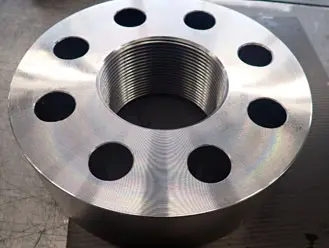
Nickel threaded Flanges

Nickel 200 Threaded Flanges

Nickel Lap Joint Flanges

Nickel 201 Lap Joint Flanges (LJRF)

Nickel Long Neck Weld Flanges

Nickel 200 Long Weld Neck Flanges (LWNRF)

Nickel Ring Type Flanges

Nickel 201 Ring Type Joint Flanges (RTJ)

Nickel Spectacle Blind Flanges

Nickel 200 Spectacle Blind and Reducing Flanges

Pressure-Temperature Ratings for Nickel 200/201 Flanges

Nickel 200/201 flanges fall under ASME B16.5 Material Group 3.12. Group 3.12 ratings hold better at elevated temperatures than carbon steel due to nickel’s creep resistance. Nickel 201 is approved by ASME BPVC Section VIII for use up to 677°C, while Nickel 200 can only be used up to 315°C.

Industrial Applications of Nickel 200/201 Flanges

Nickel 200/201 flanges support demanding industrial processes, offering reliable performance in caustic, fluorinated, food-grade, chemical, and aerospace environments:
Industrial Applications

How to Order Nickel 201 Flanges from Nicorex Alloys

To order Nickel 200 and 201 Flanges, provide these 10 important details:

Frequently Asked Questions

What ASTM specification covers Nickel 200/201 Forged Flanges?
ASTM B564 (ASME SB564) covers Nickel 200 (N02200) and Nickel 201 (N02201) forged flanges. Dimensions follow ASME B16.5 for NPS 1/2″–24″ and ASME B16.47 for NPS 26″–60″.
Yes, at all concentrations in de-aerated conditions, with corrosion rates below 0.5 mm/year at ambient. A protective NiF₂ film forms. For HF above 315°C, specify Nickel 201.
Yes, both grades are ferromagnetic with a Curie temperature of ~358°C (676°F). Above this, the alloy becomes paramagnetic. Suitable for magnetic shielding but requires consideration near sensitive instruments.
Use ERNi-1 (AWS A5.14) for TIG/GTAW welding and ENi-1 (AWS A5.11) for stick/SMAW welding. For dissimilar joints to carbon steel, use ENiCrFe-3 or ERNiCr-3. Max interpass temperature is 150°C.
The temperature is 315°C, which is about 600°F. Above this, carbon (0.15% max) causes graphitisation. For pressure piping above 315°C, specify Nickel 201; it is ASME BPVC Section VIII approved up to 677°C (1250°F).
Call Us Email Us Whatsapp Us
Phone E-mail Whatsapp