
- Home
- Welding Consumables
- HASTELLOY® B-3 Welding Wire
HASTELLOY® B-3 Welding Wire Supplier in India
Nicorex Alloys is a Mumbai-based ISO 9001 and ISO 14001 supplier and importer of HASTELLOY B-3 welding wire, TIG filler rods and MIG spools. We supply ERNiMo-10 (AWS A5.14) and ENiMo-10 (AWS A5.11) filler metals manufactured to ASME SFA 5.14 and SFA 5.11, backed by EN 10204 certificates on every shipment.
HASTELLOY B-3 welding wire consists of 68% nickel, 28.5% molybdenum, 1.5% chromium and 1.5% iron. UNS N10675 produces weld metal with about 28.5% molybdenum. This gives very high resistance to non-oxidising, reducing acids such as hydrochloric acid (HCl), sulfuric acid (H₂SO₄), acetic acid and phosphoric acid. It is a nickel alloy filler metal specially designed for pure hydrochloric acid (HCl) and reducing sulfuric acid environments. The low chromium dictates its low resistance to oxidation. It changes the ordering reaction from fast Ni₄Mo at about 750°C to slower Ni₃Mo at about 650°C. This makes welding safer and gives a wider working window. The wire is used in HCl plants, reducing sulfuric acid service, organic and phosphoric acid plants, pharmaceutical production and speciality chemicals. Storage, packaging and ordering details are also included.
Available diameters for TIG rods range from 1.6 to 3.2 mm, and for MIG, it ranges from 0.9 to 1.6 mm. All Hastelloy B-3 filler metals ship with Third-party approvals from DNV, ABS, Bureau Veritas, Lloyds Register and TÜV.
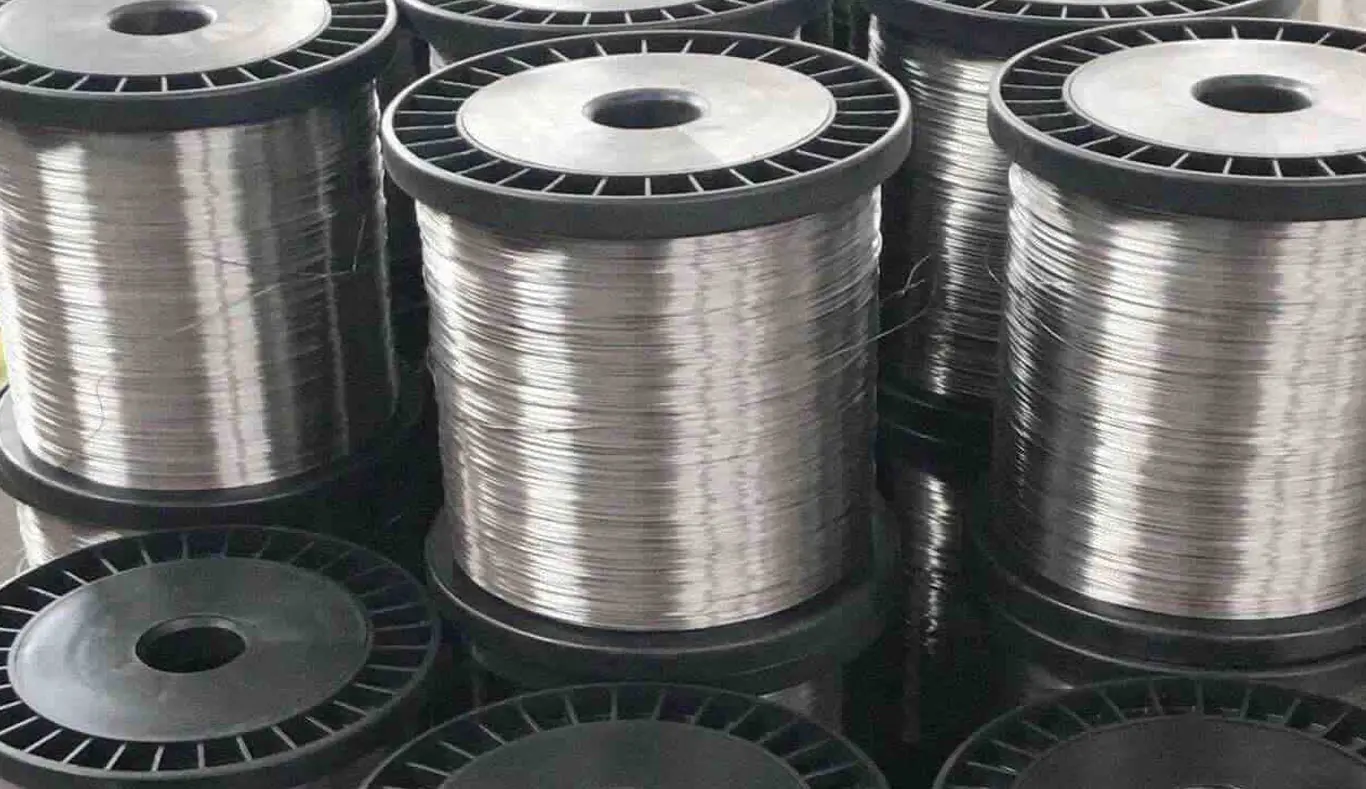
Hastelloy B-3® Welding Wire Specifications
The table below lists every specification parameter for ERNiMo-10 TIG/MIG wire and the matching ENiMo-10 SMAW electrode.
| AWS Classification | ERNiMo-10 / ENiMo-10 |
|---|---|
| AWS Specification | AWS A5.14 / AWS A5.11 |
| ASME SFA | SFA 5.14 / SFA 5.11 |
| UNS Number | N10675 / W80675 |
| Welding Processes | GTAW (TIG), GMAW (MIG), PAW, SMAW (Stick) |
| Polarity — TIG | DCEN |
| Polarity — MIG / SMAW | DCEP |
| Shielding Gas | TIG: 100% Argon | MIG: Ar/He mixtures (NO CO₂) |
| TIG Rod Diameters | 1.6, 2.0, 2.4, 3.2 mm |
| MIG Wire Diameters | 0.9, 1.0, 1.2, 1.6 mm |
| SMAW Electrode Diameter | 2.4, 3.2, 4.0 mm |
Critical: Hastelloy B-3 is more likely to crack during initial welding than C-type alloys. Always grind each arc start back to clean, sound metal or use starting tabs. Do not use SAW on B-type alloys because the high heat encourages Ni₃Mo precipitation. For GMAW, never use pure CO₂ shielding gas.
AWS Classification Explained: ERNiMo-10 (TIG/MIG Wire)
The AWS A5.14 code ERNiMo-10 can be broken down as follows.
| Term | ER | Ni | Mo | -10 |
|---|---|---|---|---|
| Meaning | Electrode/Rod — bare filler for GTAW, GMAW, SAW | Nickel base (>50% Ni) | Molybdenum as primary alloying element (~28.5%) | Tenth alloy in the NiMo series, designating B-3 composition |
Chemical Composition of ERNiMo-10 Weld Deposit (%)
The table below shows the required and typical chemical composition of ERNiMo-10 weld metal. It also highlights its high molybdenum content, which gives excellent resistance to reducing acids.
| Element | Ni | Mo | Cr | Fe | Al | Mn | C | Si | Co | P | S | Ti |
|---|---|---|---|---|---|---|---|---|---|---|---|---|
| AWS A5.14 Requirement | Balance (~68%) | 27.0–32.0 | 1.0–3.0 | 1.0–3.0 | 0.50 max | 3.0 max | 0.02 max | 0.10 max | 3.0 max | 0.03 max | 0.03 max | 0.20 max |
| Typical | 68.0 | 28.5 | 1.5 | 1.5 | 0.2 | 0.5 | 0.01 | 0.05 | 0.3 | 0.01 | 0.005 | 0.05 |
Very low carbon and silicon levels stop harmful carbide and silicide particles from forming in the weld HAZ. The chromium content is kept low on purpose because, in reducing acids, chromium doesn’t contribute to corrosion resistance; too much of it increases general corrosion. ERNiMo-10 has only 1.5% chromium. In pure reducing acids, higher chromium can speed up corrosion. Instead, the high 28.5% molybdenum content gives ERNiMo-10 its strong resistance.
All-Weld-Metal Mechanical Properties of Hastelloy B-3
B-3 weld deposits show good ductility and toughness typical of Ni-base FCC alloys. All values below are the mechanical properties of Hastelloy B3 welding wires in the as-welded condition.
| Process | Tensile Strength | Yield Strength (0.2%) | Elongation |
|---|---|---|---|
| GTAW (TIG) | ~758 MPa (110 ksi) | ~380–448 MPa (55–65 ksi) | ~40–50% |
| SMAW (Stick) | ~724 MPa (105 ksi) | ~345–414 MPa (50–60 ksi) | ~35–45% |
Base Metal Compatibility & P-Number Matrix for ERNiMo-10
Key technical specifications for W.Nr. 1.4853 according to EN 12072 and DIN 17465 are summarised below.
Similar Metal Joints:
| Base Metal | UNS | ASME P-Number |
|---|---|---|
| Hastelloy B-3 | N10675 | P-44 |
| Hastelloy B-2 | N10665 | P-44 |
Dissimilar/ Overlay:
| Joint Configuration | P-No. / Group | Typical Grades / Examples | Notes |
|---|---|---|---|
| B-3 to carbon steel | P-No. 1 (Group 1 or 2 typically) | ASTM A106 Gr. B, ASTM A516 Gr. 70, ASTM A53 Gr. B, ASTM A105 | CRA overlay for HCl service |
| B-3 to stainless steel | P-No. 8 | ASTM A240 Type 304/304L, 316/316L, 317L | Ni-base deposit avoids dilution issues |
| B-3 to other Ni alloys | P-No. 43 / 45 (depends on alloy) | Hastelloy C-276, Inconel 625, Alloy 22 | Compatible with C-276, 625 substrates |
ERNiMo-10 is often used to overlay carbon steel reactors that handle HCl and to join Hastelloy B-3 to stainless steel or to C-276 and Alloy 625. Typical compatible base metal standards include ASTM B333 pipe, B335 bars and rods, B564 forgings, B619 welded pipe, B622 seamless pipe and B626 welded tube.
Recommended Welding Parameters for Hastelloy® B-3 Wire
The table below provides detailed information on the recommended welding parameters for Hastelloy B-3 welding wires:
| Joint Thickness | Filler Dia. | Current (A) | Voltage (V) |
|---|---|---|---|
| 0.8–1.6 mm | 1.6 mm | 15–60 | 9–12 |
| 1.6–3.2 mm | 1.6–2.4 mm | 50–95 | 9–12 |
| 3.2–6.4 mm | 2.4–3.2 mm | 75–150 | 10–13 |
| >6.4 mm | 2.4–3.2 mm | 95–200 | 10–13 |
Weld-start cracking is more likely with Hastelloy B-3 than with C-type nickel alloys. Use starting tabs or grind every arc start back to sound metal. Run stringer beads only; do not weave. Keep interpass temperature at or below 93°C (200°F). Back-purge all root passes with 100% argon. If B-3 has more than 7% cold work, solution anneal at 1066°C (1950°F) and water-quench. Avoid SAW on B-type alloys.
Get Hastelloy B-3 at Competitive Prices
Industrial Applications of Hastelloy B-3 Welding Wire
ERNiMo-10 filler metal is used in five main industries where the process fluids are purely reducing and contain no oxidising contaminants.
-
HCl Production & Processing Plants: Reactors, absorbers, piping, heat exchangers and scrubbers that handle HCl at all concentrations up to boiling rely on B-3 as the standard material of construction. ERNiMo-10 is the matching TIG filler rod for these welds.
-
Sulfuric Acid - Below-Transition Reducing Conditions:Acid coolers, absorbers and dilution tanks in H₂SO₄ production operate in the reducing (non-oxidising) regime. B-3 welding wire works where chromium alloys lose protection.
-
Acetic Acid, Phosphoric Acid & Organic Acid Processing: Reaction vessels and distillation columns for acetic acid, acetic anhydride, formic acid and phosphoric acid production use ERNiMo-10 weld deposits to resist these reducing organic and inorganic acids.
-
Pharmaceutical Synthesis & Fine Chemical Production: HCl-based reactions in pharmaceutical intermediate synthesis require both corrosion resistance and product purity. B-3 filler metal meets both needs in high-purity reactor fabrication.
-
Chloroprene, Ethylbenzene & Speciality Chemical Production:Pressure vessels and reactors for chloroprene production, ethylbenzene dehydrogenation and acetic anhydride pyrolysis rely on Alloy B-3 bare rod for weld joints exposed to aggressive reducing chemistry.

Storage & Handling of Hastelloy B-3 Welding Wire
Store all ERNiMo-10 wire and rods in a clean, dry area, away from sulfur, lead, zinc and copper contamination, following the usual cleanliness standards for nickel alloys. After opening a sealed can of SMAW electrodes (ENiMo-10), keep the electrodes in a heated oven at 120-200°C.
Cold-worked Hastelloy B-3 with more than 7% outer fibre elongation must be solution annealed at 1066°C (1950°F) and then water-quenched before welding; otherwise, there are chances of HAZ cracking. Before welding, clean the filler rods and joint surfaces with acetone to remove any remaining contaminants.
Available Forms, Diameters & Packaging of Hastelloy B-3 Welding Wire
Nicorex Alloys stocks ERNiMo-10 and ENiMo-10 in the forms, diameters and packaging listed below.
| Form | Diameters | Packaging |
|---|---|---|
| TIG Rod | 1.6, 2.0, 2.4, 3.2 mm | 914 mm (36″) tubes, 5 kg packs |
| MIG Wire | 0.9, 1.0, 1.2, 1.6 mm | 15 kg spools, 12.5 kg reels |
| SMAW Electrode | 2.4, 3.2, 4.0 mm | Sealed cans (2.5 kg, 5 kg) |
How to Order Hastelloy B-3 Welding Wire from Nicorex Alloys
Provide the following details when placing your enquiry for Hastelloy B-3 welding wires from Nicorex Alloys:
- Wire Type (GTAW / GMAW)
- Size (TIG cut lengths, MIG spools and coils)l
- Current Type DCEN (GTAW) / DCEP (GMAW) — specify process and diameter
- Welding Position (All Positions, specify process and positional requirements)
- Material Grade (Hastelloy B-3 Welding Wire / UNS N10675 / AWS A5.14: ERNiMo-10 / W.Nr. 2.4600)
- Quantity
- Standard (AWS A5.14 / ASME SFA 5.14 (ERNiMo-10), EN ISO 18274: S Ni 1067, ASME Section IX)
- Documentation (MTC EN 10204 3.1/3.2, PMI Report, Mechanical Properties Report, TPI Certificate)
- Packaging (Vacuum-sealed bags)
- Delivery Destination (domestic/international)
Custom packaging and project-specific documentation are available on request.
Frequently Asked Questions - Hastelloy B-3 Welding Wire (ERNiMo-10)
What is the difference between ERNiMo-10 (B-3) and ERNiMo-7 (B-2) welding wire?
Hastelloy B-3 is more thermally stable than B-2. By adjusting minor elements, it changes the ordering reaction from fast Ni₄Mo at ~750°C to slower Ni₃Mo at ~650°C. This creates a wider, safer welding and processing window with much lower embrittlement risk.
Why can Hastelloy B-3 not be used in oxidising acid environments?
Hastelloy B-3 has only about 1.5% chromium, so it cannot form a protective Cr₂O₃ film. In oxidising acids like HNO₃, FeCl₃, or hot oxidising H₂SO₄, it corrodes quickly.
Why must cold-worked Hastelloy B-3 be solution annealed before welding?
Cold work above about ~7% creates residual stresses and speeds up intermetallic formation during welding, making Hastelloy B-3 very prone to HAZ cracking. Solution annealing at 1066°C (1950°F) followed by a water quench restores ductility and lowers sensitisation risk.
Can ERNiMo-10 be used for cladding Carbon steel vessels for HCl service?
Yes. ERNiMo-10 is widely used to clad carbon steel reactors, columns and piping that handle HCl. Use several layers to get the right chemistry and keep the iron dilution low. GTAW with oscillation or short-circuit GMAW helps minimise dilution.
Does Nicorex Alloys supply ERNiMo-10 welding wire with DNV or ABS approval?
Yes. Nicorex Alloys can supply ERNiMo-10 TIG rods and MIG wires with third-party approvals from DNV, ABS, Lloyd’s Register, Bureau Veritas and TÜV. Please mention the required approval when you send your enquiry.
What is the maximum service temperature for Hastelloy B-3 Weld deposits?
Hastelloy B-3 resists reducing acids up to their boiling point. For long-term use, keep service temperatures below about 550°C (1020°F) to avoid Ni₃Mo embrittlement.