
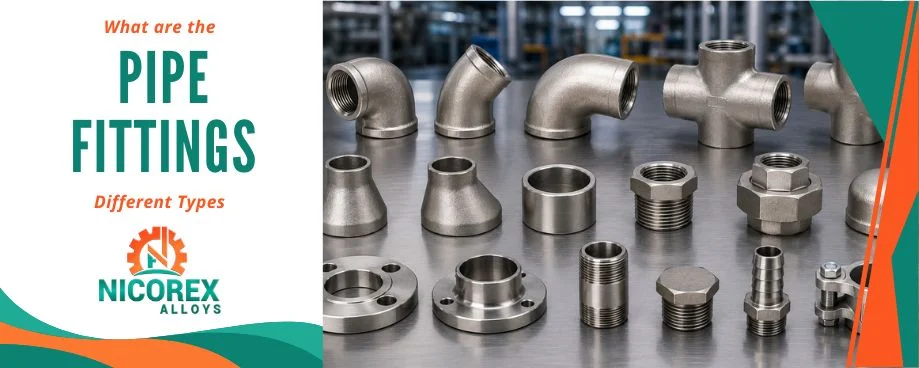
Pipe fittings are essential components in any piping system. They connect pipes, change flow direction, branch pipelines, reduce pipe sizes, and seal pipe ends. Without the right fittings, even a well-designed piping layout can run into performance issues or maintenance problems over time.
In industrial setups, fittings are not just accessories. They directly influence flow behaviour, pressure drop, and overall system reliability. This guide covers the major pipe fitting types used in industrial piping, along with their functions, connection methods, materials, and applicable standards.
What is a Pipe Fitting?
A pipe fitting is a component used to connect, redirect, reduce, or close pipe sections within a piping system. These fittings make it possible to build complex pipeline networks that can navigate around equipment, split into multiple lines, and accommodate changes in pipe size. At the same time, they need to maintain pressure integrity.
Pipe fittings are available in three main connection types:
- Butt weld fittings are welded directly to the pipe, creating a permanent and high-strength connection. These are used in high-pressure or high-temperature systems.
- Socket weld fittings involve inserting the pipe into a recessed area and then fillet welding it. They are used in small-bore, high-pressure lines.
- Threaded fittings are screwed onto the pipe without welding. They are easier to install but are generally limited to low-pressure applications.
Elbows
Elbows are the most commonly used pipe fittings. Their primary function is to change the direction of flow, and they come in different angles and radius configurations depending on the requirement.
90-Degree Elbow
This type changes the direction of flow by 90 degrees and is used across most piping systems. The two elbow fitting types are mentioned below.
- Long radius elbows have a centerline radius equal to 1.5 times the pipe diameter. They are preferred in most cases because they result in lower pressure drop and smoother flow.
- Short radius elbows, on the other hand, have a centerline radius equal to the pipe diameter. They are used where space is limited, although the sharper turn increases turbulence.
45-Degree Elbow
A 45-degree elbow changes the flow direction more gradually. In practice, two of these can be combined with a short straight section to create offsets in piping runs. That approach is fairly common in layout adjustments.
180-Degree Return Bend
This fitting reverses the direction of flow completely. It is often used in heat exchanger coils or systems where the fluid needs to return along a parallel path.
Reducing Elbow
A reducing elbow performs two functions at once. It changes direction while also reducing pipe size. This avoids the need for a separate reducer and helps minimise the number of weld joints, which can be beneficial in tighter layouts.
Tees
A tee pipe fitting is used to create a branch connection from the main pipeline at a 90-degree angle. They are the second most widely used fittings after elbows.
- Equal tees have all three openings of the same size. They are used when the branch line needs to carry the same flow capacity as the main run.
- Reducing tees have a smaller branch opening. These are used when the branch requires a lower flow rate. In many cases, they are preferred over using an equal tee with an additional reducer because the setup is more compact.
- Barred tees include internal bars across the branch opening. These are used in pipelines that undergo pigging operations, where the bars prevent the pig from entering the branch line. Not every system needs this, but in the right application, it becomes essential.
Reducers
Reducer pipe fitting is used to connect pipes of different sizes and allow a smooth transition in the system.
- Concentric reducers keep the centerline aligned. The shape is symmetrical, which makes them suitable for vertical piping systems or wherever alignment is important.
- Eccentric reducers are slightly different. Their centerlines are offset, which creates a flat side. This detail matters more than it seems.
When installed with the flat side on top, they help prevent air pockets in pump suction lines. When installed with the flat side on the bottom, they assist with proper drainage. These small installation choices can affect system performance.
Couplings
A coupling pipe fitting is used to join two pipes of the same size in a straight line. Compared to flanged connections, they are simpler and more compact.
- Full couplings connect two pipes directly and are commonly available in threaded pipe fittings or socket-weld forms for small-bore piping.
- Half couplings are used slightly differently. One end is welded to a larger pipe, creating a branch outlet. This setup is somewhat similar to a weldolet, though usually more economical.
- Reducing couplings connect pipes of different sizes. They function like small reducers but are mainly used in compact piping arrangements.
Unions
A union pipe fitting provides a connection that can be easily dismantled without cutting the pipe. It consists of three parts: a nut, a male end, and a female end.
The main advantage is in maintenance. Unlike a coupling, a union does not require pipe rotation for disassembly. Loosening the central nut is enough to separate the joint, which saves time during equipment replacement or repair.
Caps and Plugs
Caps are used to close the end of a pipe from the outside. They are placed over the pipe end and can be welded or threaded into position. Caps are typically used in dead-end lines or where future expansion may be planned.
Plugs serve a similar purpose but are installed internally. They fit into threaded openings and are available in different head types, such as hex, square, or round. Selection usually depends on accessibility and tool requirements.
Crosses
A cross pipe fitting connects four pipe sections at a single junction. While this may seem efficient, it is not commonly used in process piping. The reason is stress distribution. When four pipes intersect, the stress concentration becomes more complex and harder to manage. Because of this, most designs prefer using two tees instead. Cross fittings are more common in low-pressure systems such as fire sprinkler lines, where the stress concerns are less critical.
Nipples
A nipple is a short length of pipe with threads on both ends. It is used to connect two fittings or extend a connection slightly.
- Close nipples are threaded along their entire length, leaving no unthreaded section.
- Short nipple: Has a small unthreaded section in the middle
- Long nipple: Has a longer unthreaded section between the threaded ends
Bushings
Bushings are small fittings used to connect pipes of different sizes. They have external threads on one side and internal threads on the other. They are often used as a compact alternative to reducing couplings in threaded systems, especially where space is limited.
Stub Ends
Stub ends are used with lap joint flanges. They are welded to the pipe, while the flange itself remains loose and can rotate. This arrangement allows the use of a lower-cost flange material since only the stub end comes into contact with the process fluid. It also simplifies alignment during installation, which is a practical advantage in many projects.
Connection Types and Standards
Butt Weld Fittings
- Standard: ASME B16.9 (factory-made wrought butt-welding fittings)
- Sizes: NPS 1/2 to NPS 48
- Wall thickness: Matches the connecting pipe schedule
- Best for: High-pressure, high-temperature, and critical service
Socket Weld Fittings
- Standard: ASME B16.11 (forged fittings, socket weld and threaded)
- Sizes: NPS 1/2 to NPS 4 (most common up to NPS 2)
- Pressure classes: 3000#, 6000#, 9000#
- Best for: Small-bore, high-pressure piping
Threaded Fittings
- Standard: ASME B16.11 (forged pipe fittings)
- Sizes: NPS 1/2 to NPS 4
- Pressure classes: 2000#, 3000#, 6000#
- Best for: Low-pressure, non-critical service, utility piping
Pipe Fitting Materials
| Material | Application | Product Link |
|---|---|---|
| Carbon Steel (A234 WPB) | General service, moderate temp | — |
| Stainless Steel 304/316 | Corrosion resistance, food/pharma | — |
| Hastelloy C276 | Extreme acid resistance | Chemical processing |
| Hastelloy C22 | Versatile corrosion resistance | Pharma, chemical |
| Inconel 600 | High-temperature service | Heat treatment, nuclear |
| Inconel 625 | Marine and acid resistance | Offshore, subsea |
| Incoloy 825 | Sulfuric/phosphoric acid | Chemical plants |
| Monel 400 | HF acid and seawater | Refineries, marine |
| Duplex S31803 | Chloride SCC resistance | Offshore platforms |
| Super Duplex S32750 | High strength + corrosion | Subsea, oil & gas |
How to Select the Right Pipe Fitting
- Selecting a pipe fitting usually starts with identifying its function. Whether the requirement is to change direction, create a branch, reduce size, or close a line will narrow down the options quickly.
- The connection type is the next factor. Butt weld fittings are used for high-pressure systems, socket weld fittings for small-bore high-pressure lines, and threaded fittings for lower-pressure applications.
- Material selection should match the pipe to avoid compatibility issues such as galvanic corrosion. This is especially important in corrosive environments.
- Standards also play a role. ASME B16.9 covers butt weld fittings, while ASME B16.11 applies to socket weld and threaded fittings.
- Wall thickness, or schedule, must be considered as well. The fitting should match or exceed the pipe thickness.
- Finally, design codes such as ASME B31.1 or B31.3 may impose restrictions depending on the service conditions.
Frequently Asked Questions
What is the most commonly used pipe fitting?
The 90-degree long-radius elbow is the most widely used fitting because it changes direction efficiently while keeping pressure losses relatively low.
What is the difference between a coupling and a union?
A coupling is more permanent and typically requires pipe rotation for removal. A union, by comparison, can be disconnected by loosening a central nut.
When should I use a concentric vs an eccentric reducer?
Concentric reducers are used in vertical lines where alignment matters. Eccentric reducers are used in horizontal systems to control air accumulation or drainage.
What does the pressure class mean for socket weld fittings?
The pressure class indicates the maximum allowable working pressure at ambient temperature. Higher classes correspond to thicker walls and greater strength.
Can I mix butt weld and socket weld fittings in one system?
While it is technically possible, it is generally avoided. Mixing connection types can complicate inspection and create differences in stress behaviour.
Conclusion
Understanding the different types of pipe fittings is essential for designing reliable piping systems. Each fitting serves a specific purpose, whether it is changing direction, branching flow, adjusting pipe size, or closing a line.
Selecting the correct fitting involves more than just choosing the shape. Connection type, material compatibility, pressure rating, and applicable standards all need to be considered. In more demanding environments, specialised alloy fittings such as Hastelloy, Inconel, Monel, or duplex steels are often used to ensure long-term performance.
Need pipe fittings in speciality alloys? Get in touch with us today.