
Alloy 230-W Welding Electrode Supplier in India
Nicorex Alloys is an ISO 9001 certified supplier and stockist of ENiCrWMo-1 welding electrodes and welding rods in Mumbai, India. We supply common diameters at fair prices, and also provide EN 10204/3.1B mill test certificates for quality assurance. Our stock is available for quick and reliable delivery all over India.
The Alloy 230-W coated electrode is a nickel-chromium-tungsten-molybdenum flux-coated consumable classified as ENiCrWMo-1 under AWS A5.11 / ASME SFA 5.11 (UNS W86231, ASME IX F-43, ISO 14172). It is designed for SMAW welding of Alloy 230 (UNS N06230, Werkstoff 2.4733), a solid-solution-strengthened superalloy for extreme high-temperature service up to 2100°F (1149°C). In SMAW practice, welders refer to this as the 230-W stick electrode for gas turbine and industrial furnace components.
This filler electrode produces a weld deposit with excellent long-term thermal stability. It typically does not form any sigma phase, mu phase, or deleterious phase formation even after 16,000+ hours of exposure at 1200-1600°F. The combination of approximately 14% tungsten and around 2% molybdenum provides exceptional creep‑rupture strength, allowing Alloy 230 weld metal to significantly outperform Alloy X at all temperatures above 1400°F in long-term creep-rupture performance. It provides outstanding oxidation resistance for continuous service up to 2100°F (1149°C). The weld deposit also resists nitriding, carburising, and oxidising environments.
Low-cobalt content (≤5% Co) reduces activation concerns and raw material cost. Standard electrode diameters range from 2.4 mm to 4.7 mm, all for use with DCEP polarity. Key industries include aerospace, gas turbines, power generation, industrial heating, chemical processing, and emerging technologies. Contact Nicorex Alloys for a quotation with MTC and fast dispatch.
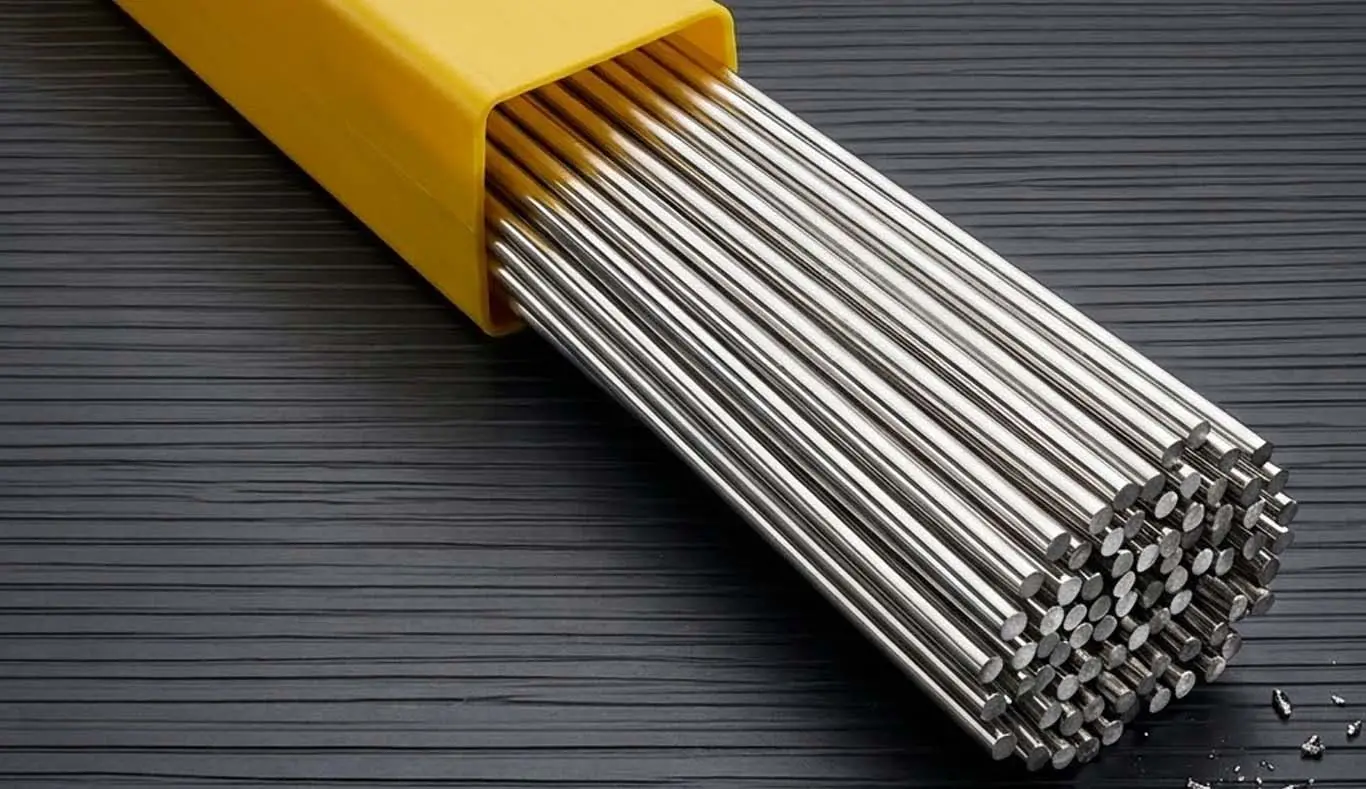
Alloy 230-W Coated Electrode Specifications & Classifications
| AWS A5.11 | ENiCrWMo-1 |
|---|---|
| ASME SFA 5.11 | ENiCrWMo-1 |
| ASME IX F-Number | F-43 |
| UNS (Electrode) | W86231 |
| UNS (Base Metal) | N06230 |
| Werkstoff Nr. | 2.4733 (base metal) |
| Welding Process | SMAW (Shielded Metal Arc Welding / Stick Welding) |
| Polarity | DCEP (Direct Current Electrode Positive) |
| Position | All positions (F, H, OH, VU); out-of-position limited to 2.4 & 3.2 mm |
| Coating Type | Proprietary flux (slightly basic to slightly acidic per Haynes) |
| Delivery | Hermetically sealed moisture-proof canister |
Chemical Composition of ENiCrWMo-1 Weld Deposit (%)
| Material / Element | Nickel (Ni) | Chromium (Cr) | Tungsten (W) | Cobalt (Co) | Iron (Fe) | Molybdenum (Mo) | Manganese (Mn) | Silicon (Si) | Aluminium (Al) | Carbon (C) | Lanthanum (La) |
|---|---|---|---|---|---|---|---|---|---|---|---|
| Composition (%) | 57 (Balance) | 22 | 14 | 5.00 max | 3.00 max | 2 | 0.5 | 0.4 | 0.3 | 0.1 | 0.02 |
Mechanical Properties of ENiCrWMo-1 Weld Deposit
| Property | Tensile Strength (min) | Elongation (min) | Density (base alloy) | Melting Range (base alloy) |
|---|---|---|---|---|
| Value | 620 MPa (90,000 psi) | 20% | 8.97 g/cm³ (0.324 lb/in³) | 1301-1371°C (2375-2500°F) |
Room-temperature minimums do not reflect the true advantage. At 927°C (1700°F) and above, Alloy 230 weld metal delivers significantly higher stress-rupture strength than Alloy X, making it the premier choice for long-term high-temperature structural service.
Base Metals Welded with Nickel Alloy 230-W Electrode
Get Alloy 230-W Welding Electrode at Competitive Prices
Industries & Applications of Alloy 230-W Welding Electrode
- Combustion can fabrication, transition duct welding, flame holder assembly, thermocouple sheath joining, and afterburner components.
- Land-based gas turbine combustor fabrication and repair, HRSG components, concentrated solar power (CSP) receiver tube welding. Covered by ASME Section VIII Div 1 and Section I Code Cases.
- Furnace retort fabrication, heat-treating basket assembly, radiant tube welding, muffle construction, and nitriding furnace internals.
- Nitric acid catalyst grid support fabrication (Alloy 230's flagship chemical application per Haynes), high-temperature heat exchangers, and bellows fabrication.
- High-temperature hydrogen production, solar thermal receivers, next-generation nuclear heat exchangers, and supercritical CO₂ power cycle components.
- Field and shop repair of gas turbine combustion components and furnace retorts.

Storage & Handling of ENiCrWMo-1 Coated Electrodes
- Unopened: Keep sealed in original hermetically sealed moisture-proof canister. Store in a dry area.
- After opening: Transfer all electrodes to the electrode storage oven at 250–400°F (121–204°C).
- Atmospheric exposure: If exposed to an uncontrolled atmosphere, recondition at 600–700°F (316–371°C) for 2–3 hours.
- Max reconditioning: 3 cycles. Discard if coating becomes brittle or flakes.
- Interpass temperature: Maintain below 200°F (93°C) — auxiliary cooling methods acceptable if they don’t introduce contaminants.
- No preheat required. Room temperature (typical shop conditions) is standard.
Available Electrode Sizes & Recommended Welding Parameters
| Dia (mm) | Dia (in) | Length | Pack Wt. | Current (A) | Polarity |
|---|---|---|---|---|---|
| 2.4 | 3/32 | 305 mm | 0.9 kg (2 lb) | 40-70 | DCEP |
| 3.2 | 1/8 | 355 mm | 2.3 kg (5 lb) | 70-105 | DCEP |
| 4.0 | 5/32 | 355 mm | 4.5 kg (10 lb) | 100-150 | DCEP |
| 4.7 | 3/16 | 455 mm | 4.5 kg (10 lb) | 130-175 | DCEP |
How to Order Alloy 230-W Welding Rod from Nicorex Alloys
- Wire Type — GTAW; AWS A5.14 / ASME SFA-5.14: ERNiCrWMo-1
- Size — 1.6 mm, 2.4 mm, 3.2 mm; cut lengths (914 mm / 1000 mm)
- Current Type — DCEN only
- Welding Position — All positions (1G, 2G, 3G, 4G, 6G)
- Material Grade — Haynes 230; UNS N06230; W.Nr. 2.4733; EN ISO 18274: S Ni 6230
- Quantity — Specify number of packs (5 kg) or total kg required
- Standard — AWS A5.14 / ASME SFA-5.14; EN ISO 18274; ASME Section IX
- Documentation — MTC EN 10204 3.1/3.2; PMI Report; TPI certificate
- Packaging — Rigid plastic tubes or cardboard box; ISPM 15 compliant export cartons
- Delivery Destination — Domestic / International; specify port or delivery address
Frequently Asked Questions
What Makes Alloy 230-W the Preferred Coated Electrode for Gas Turbine Combustors?
Is Preheat or Postweld Heat Treatment Required for ENiCrWMo-1?
No preheat required. Room temperature is standard. Interpass below 200°F (93°C). PWHT is not generally required. Solution heat treatment (2150-2275°F / 1177-1246°C) is only needed if optimal base metal properties are required.
Why is Out-of-Position Welding Limited with ENiCrWMo-1 Stick Electrode?
Nickel-base molten weld metal is inherently sluggish. As per Haynes, out-of-position SMAW is generally only feasible with 2.4 mm and 3.2 mm electrodes. Larger diameters (4.0, 4.7 mm) for flat and horizontal only. Use stringer beads; wide weave is not recommended.
What is the Maximum Continuous Service Temperature for ENiCrWMo-1 Weld Deposits?
2100°F (1149°C) is the maximum continuous service temperature for ENiCrWMo-1 weld deposits.
Can ENiCrWMo-1 Welding Rod Be Used for Dissimilar Joints to Alloy X?
What is the Difference Between ENiCrWMo-1 and ENiCrCoMo-1 (Inconel 117)?
ENiCrWMo-1 (230-W) is tungsten-strengthened (13-15% W) and has a low-cobalt content. ENiCrCoMo-1 (Inconel 117) is cobalt-strengthened (~12% Co) for Inconel 617. Choose ENiCrWMo-1 when low cobalt is required (cost, nuclear) or when welding Alloy 230. Choose ENiCrCoMo-1 for Inconel 617 base metal.
OUR PRODUCTS
- Welding Consumables
- Coated Electrodes
- MIG & TIG
- Welding Wire
- SAW & Flux
- Sheets & Plates
- Pipes & Pipe Fittings
- Round Bar
- Flanges
- Fasteners